
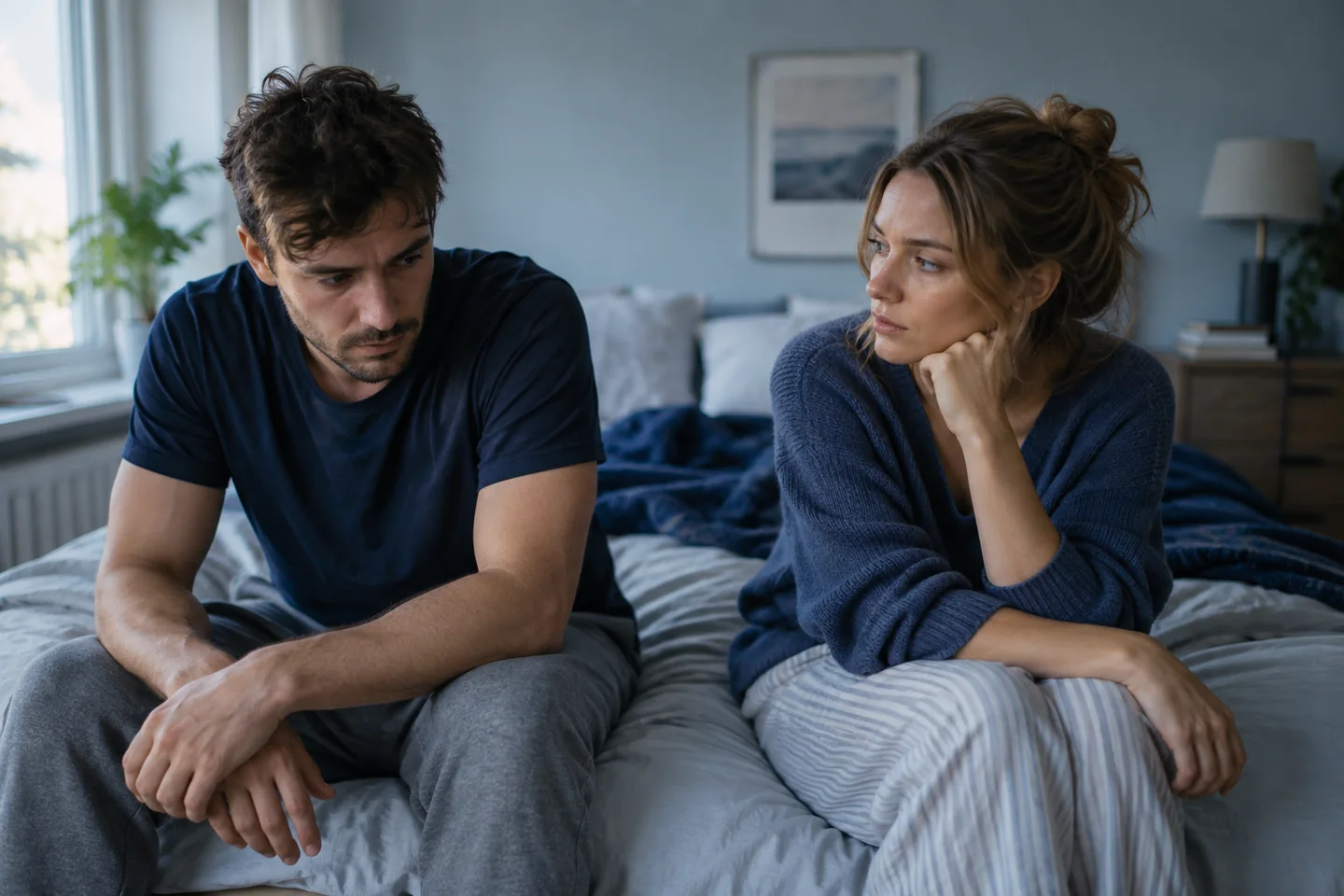
If you can get hard alone but not with a partner, you are far from the only one, and it rarely comes down to a single cause. The difference is useful information: your body can produce an erection, so the question becomes what changes when another person is there. Nerves, alcohol, condoms, tiredness, pressure, medicines and health can all play a part, and for some men, so can solo habits built around porn.
The pattern is common enough to show up in research. In a survey of 4,209 men with and without a sexual dysfunction, Rowland and colleagues found consistently less impairment during masturbation than during partnered sex, for erection difficulties as well as early and delayed ejaculation. The study did not explain why. Read the study. So the difference is worth bringing to an assessment, but it is not a home test that identifies one cause.
Why can I get hard alone but not with my partner?
Alone, you control the timing, the pace, the kind of touch, and whether to stop. With someone else, all of that is shared, and several things can get in the way:
- Performance anxiety. One difficult night can turn the next into a test. Watching yourself for signs of failure pulls attention away from arousal. See how performance anxiety and comparison can feed each other.
- A new partner or a high-stakes moment. First times, wanting to impress, or feeling you have something to prove raise the pressure most.
- Alcohol and drugs. The NHS lists drinking too much among the temporary causes of erection problems, alongside stress and tiredness. NHS overview.
- Condoms. In a study of 479 young men, poorly fitting condoms and worry or distraction during condom use were linked with losing erections, and the authors suggest this can become a repeating cycle. Read the study.
- Fatigue and stress. Sex at the end of a long day asks more of your body than a few minutes alone.
- Medicines. NIDDK lists antidepressants, blood pressure medicines, antihistamines and several others as possible contributors. NIDDK on medicines.
- Relationship pressure. Conflict, unspoken expectations, trying to conceive, or sex that feels like a duty can all show up in the body.
- Mood and health. NIDDK also names anxiety, depression, low self-esteem and negative body image, as well as diabetes, heart and blood vessel disease, and hormone problems.
Getting hard alone does not rule out a physical cause. More than one of these can be involved at the same time. If it is desire that has dropped rather than the erection, see causes of low libido in your 20s.
When should I see a doctor?
The NHS advises seeing a GP or a sexual health clinic if erection problems keep happening. NHS guidance. Book an appointment sooner if:
- erections are also weaker alone, or morning erections have mostly stopped;
- the change started after a new medicine (talk to the prescriber rather than stopping it yourself);
- you have diabetes, high blood pressure, high cholesterol or heart problems, or you smoke. NIDDK notes that erectile dysfunction may be a symptom of another health problem;
- you notice pain, a new bend in the penis, or lower desire together with unusual tiredness;
- you have started avoiding sex or closeness, or the worry is affecting your mood.
If you are having thoughts of harming yourself, contact emergency services or a crisis line now.
You do not need to settle on a theory before you go. Ryan, 32, describes short-lived erections and avoiding penetration before he saw a sexologist. Prescribed medication helped, but he then developed high blood pressure, which made him question whether it was right for him. His story is a reminder that several things can be going on at once, and that it helps to work through them with a professional.
Could porn or my solo habits be part of it?
This is the cause people rarely check. Research on whether porn is linked with erection problems is mixed, and the pattern of use seems to matter more than how often someone watches. Our guide to porn and erection problems covers that evidence. In Ince and colleagues’ qualitative research, people who saw their own porn use as a problem described sexual difficulties with partners alongside it. These are reported experiences. They cannot show a single cause or a sequence that applies to everyone. Read the study.
A short self-check:
- Do erections work reliably with porn, but not with a partner or when you are alone without porn?
- Do you still get morning or spontaneous erections? The NHS notes that, depending on the cause, erections at other times such as waking can still happen.
- Have you needed more novel, more intense or more specific content to get aroused?
- Does your solo routine depend on a grip, speed or pressure that a partner’s touch does not match?
- After a difficult encounter, do you go back to porn instead of talking about it?
- Have you tried to cut back and found it harder than you expected?
Several yes answers suggest your solo habits are worth looking at alongside the other causes, not instead of them. None of these answers is a diagnosis.
What people describe
Arjun writes about years of being unable to get an erection with every partner he was with, first blaming cigarettes and weekend drinking. After another night when nothing happened with a partner, he writes, “I ran home, turned on porn and immediately became fully erect.” Read his story. Content warning: it includes explicit descriptions and suicidal thoughts.
A 30-day experiment
If the self-check sounded familiar, you can choose a 30-day window to observe what changes. It is not a cure or a recovery timeline. It is a way to collect information.
- Write down a starting point. Note morning erections, sleep, alcohol, stress, and how intimacy has felt lately. Add a line or two each day.
- Change the solo routine. Decide whether to leave porn out of masturbation or stop masturbating for the month. If you keep masturbating, try a lighter touch and a slower pace, closer to what a partner’s touch is like.
- Make porn harder to reach on your phone. Turn on a content blocker or your phone’s built-in screen-time limits (step-by-step for iPhone and Android), and charge the phone outside the bedroom.
- Take the pressure off partnered sex. Talk outside the difficult moment, for example: “I have been worried about my response, and I want to look at my own habits. This is not about you.” Agree on touch that has no goal of intercourse. Neither of you owes the other sex to prove anything. How to talk to your partner about porn has more on this.
- Deal with the other causes too. Drink less before sex, try different condom sizes, protect your sleep, and keep any doctor’s appointment you need.
At the end, read your notes. If things improved, that is useful, although several changes at once cannot tell you exactly which one helped. If nothing changed, you have not failed, and your notes are a good starting point for a clinician.

No published comments yet.