
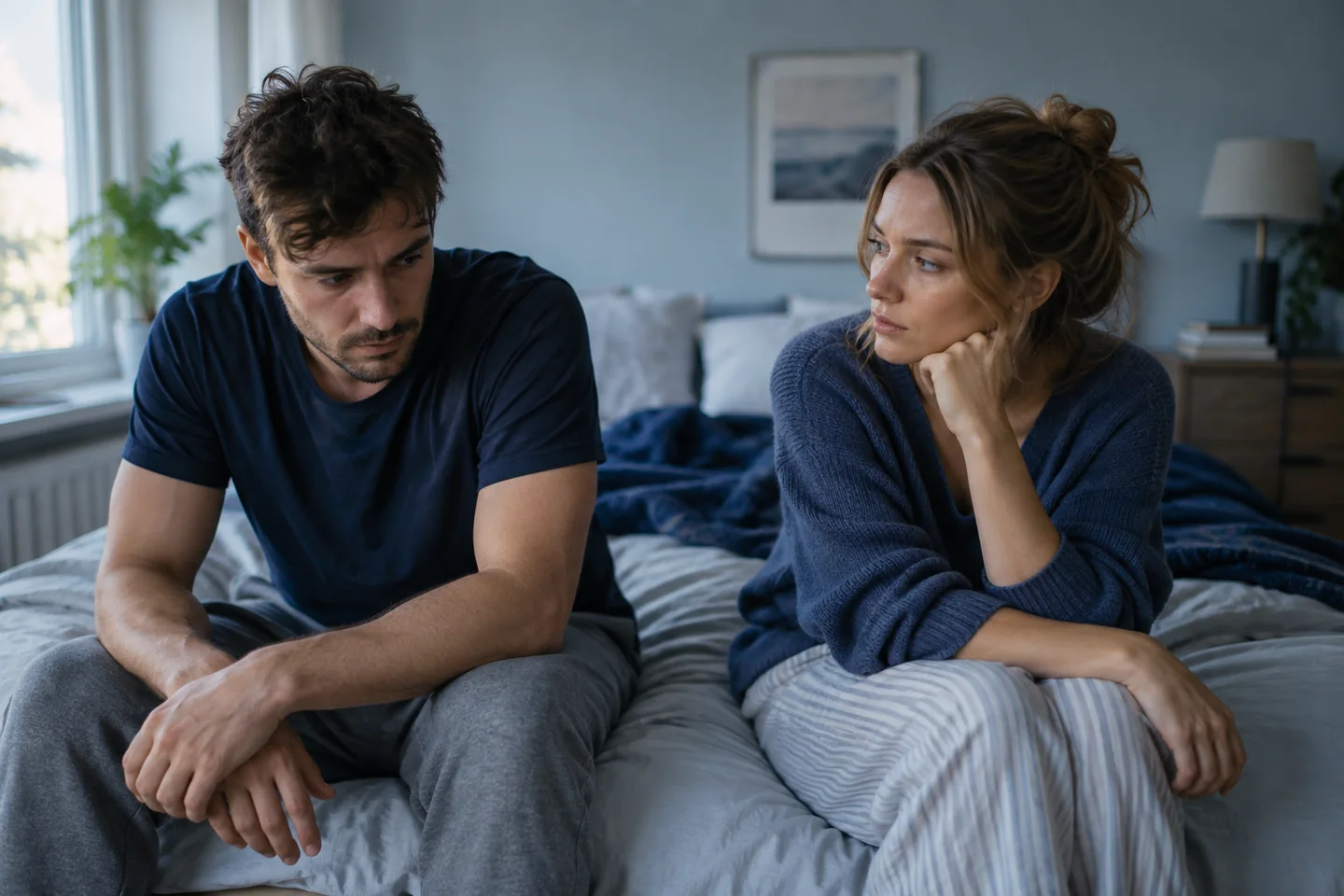
You can want someone, care about them, and still find yourself dreading the moment when sex might happen.
Perhaps arousal feels straightforward with a screen but uncertain with a partner. Perhaps you have begun avoiding closeness because you do not want another difficult encounter. What used to feel spontaneous now comes with a question: will my body cooperate?
The difference deserves attention. It does not, by itself, tell you that you no longer find your partner attractive.
Describe what “easier” means
This word can cover several different experiences. You might mean that desire appears more readily, that erections are more reliable, that orgasm happens more easily, or simply that being alone feels less demanding.
Separate those questions. They may need different kinds of help.
In Rowland and colleagues’ survey, men reported less impairment during masturbation than partnered sex across erection, early-ejaculation, and delayed-ejaculation difficulties. The researchers could not establish an explanation for that difference. Read the study.
It is therefore useful information to bring to an assessment, not a home test that identifies a porn-induced condition.
Look at the whole setting
Alone, you can choose the timing, pace, stimulation, and whether to stop. With another person, the encounter also includes their preferences and responses. Ask which differences matter in your experience rather than assuming they all do.
For example:
- Are you concerned about disappointing your partner?
- Has sex started feeling like a performance check?
- Are there unspoken expectations about what should happen?
- Do you avoid talking about what you find comfortable or pleasurable?
- Has a particular screen-based routine become the only setting you willingly choose?
These are conversation prompts, not a diagnostic checklist. You do not need to answer them through repeated sexual testing.
Where problematic porn use may fit
Participants in Ince and colleagues’ qualitative research described sexual difficulties with partners alongside self-identified problematic porn use. These accounts show a concern that affected people report; they cannot establish a single cause or a universal sequence. Read the study.
If the pattern is familiar, describe both sides: what happens with porn, and what happens in the relationship. “I keep choosing a solitary routine and avoiding intimacy” is a more workable starting point than “my partner cannot compete.”
Your partner is a person with their own experience, not a stimulus that needs upgrading.
Have a conversation outside the difficult moment
Pick a time when neither of you is being asked to have sex or explain a recent encounter on the spot.
An example opening might be: “I miss feeling relaxed with you. I have noticed that I am avoiding sex because I am worried about my response. I also want to look honestly at my porn use. This is not a request for you to perform differently.”
You can discuss closeness without making intercourse, erection, or orgasm an obligation. Agree only to contact that both people genuinely want. Neither person owes the other a sexual activity to prove attraction or support recovery.
See how to talk to your partner about porn for a fuller conversation guide.
Seek help for the symptom as well as the pattern
Anxiety, stress, medicines, and physical health conditions can contribute to erection difficulties. A clinician can explore those possibilities alongside your concerns about porn. NIDDK’s overview.
If the difficulty is recurring, troubling, or causing avoidance, ask for an assessment rather than relying on a fixed abstinence timetable. A qualified sex therapist or clinician may help you discuss the sexual and relational context.
The goal is not to make your body pass an exam. It is to understand what is happening and recover room for a sexual life that feels wanted, comfortable, and shared.
No published comments yet.