
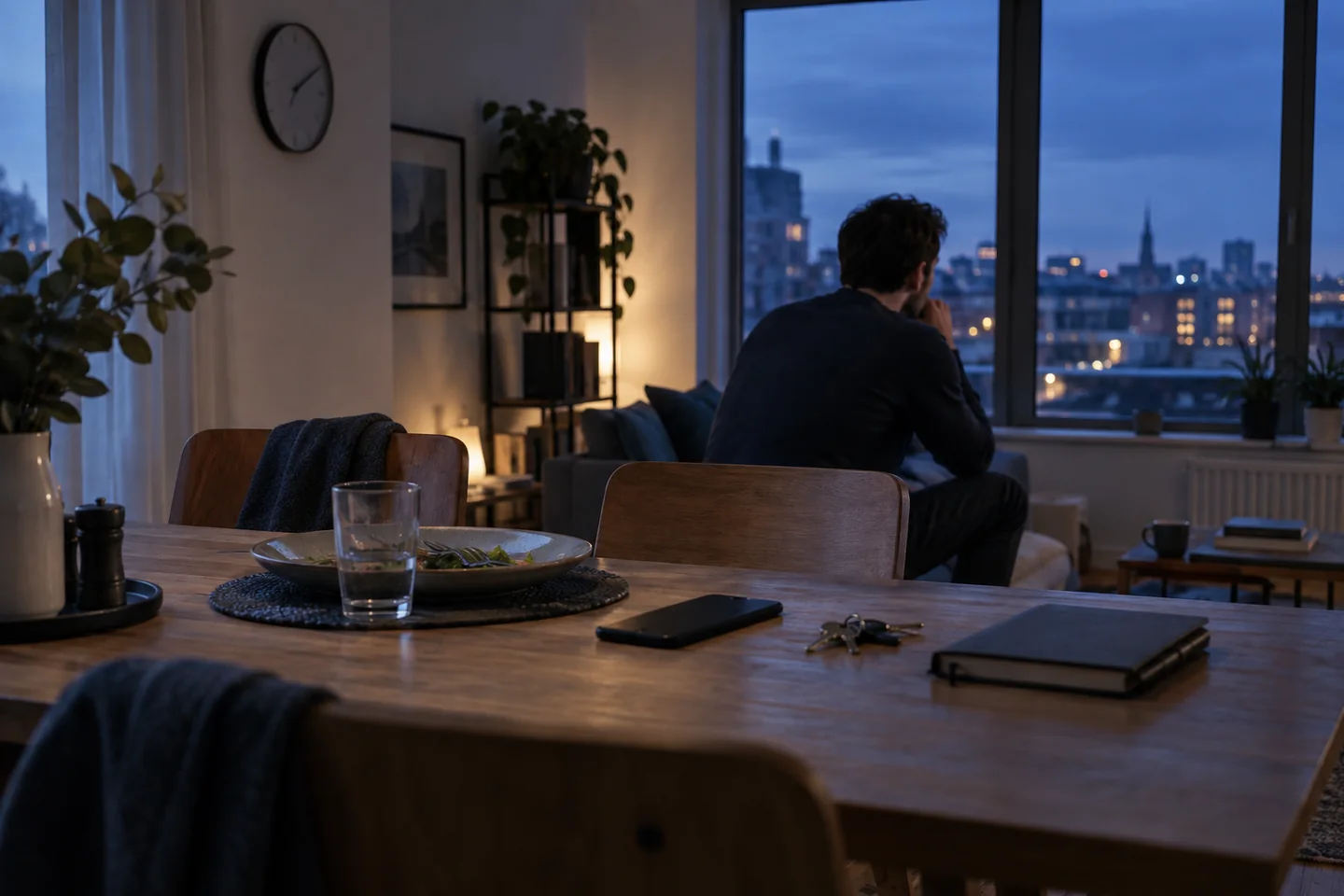
Imagine an ordinary evening. You have finished work, there is something you meant to do, and you pick up your phone for a few minutes. When you next notice the time, the evening has almost gone.
Nothing dramatic happened. That may be exactly what makes the pattern easy to dismiss.
A missed evening does not come with a bill. But if you keep spending time in a way you did not choose, it is worth asking what is being crowded out.
Count the whole evening
Start with the obvious part: when you began watching and when you stopped. Then look at what happened around it.
Did a task move to tomorrow? Did you leave a message unanswered? Did you go to bed later than you wanted? Did you decide not to meet someone because you no longer had time?
These are examples to compare with your own experience, not a list of effects that must occur. The point is to describe the actual cost instead of reaching for a broad verdict such as “I have no motivation.”
“I postponed the same task three times” is more useful than “I am wasting my life.” One describes something you can change. The other leaves very little room to begin.
Prolonged sessions are part of the research
Ince and colleagues’ qualitative study of 67 people with self-identified problematic use documented prolonged sessions and complaints after heavy use. These were participants’ accounts, not measurements proving that porn caused every subsequent symptom. Read the study.
That distinction still leaves room to take an individual evening seriously. If you watched until late and missed the bedtime you had chosen, the schedule itself tells you something. You do not need to establish a neurological mechanism before deciding you want that time back.
For the question of what keeps a session going, read “one more video”. Here, the focus is what happens to everything else.
What were you hoping the evening would feel like?
It is possible to have free time without feeling able to use it well. Perhaps work left you tense, your plans fell through, or you wanted a break that required nothing from you.
Hanseder and Dantas interviewed 13 men who considered their porn use addictive. Participants described using it to escape difficult emotions or boredom, alongside difficulty stopping despite unwanted consequences. Read the interviews study.
Use that as a question rather than an explanation imposed on you: what was the session doing for you? If it provided relief, your replacement plan needs to make room for relief too. A punishing schedule of self-improvement may not answer the need that brought you to the screen.
Try an evening review, not a productivity score
For a few evenings, make a brief private note:
- What did I want from tonight?
- What did I actually do?
- Where did the plan change?
- What would have made a different choice easier?
You choose the observation period. It is not a diagnostic test or an evidence-based recovery deadline.
Look for one recurring point you can act on. For example, if aimless phone use in bed repeatedly becomes a long session, you could try charging the device elsewhere while keeping another way to receive essential calls. If the difficult moment is arriving home alone, plan something realistic for that transition.
These are practical experiments, not proven standalone treatments for problematic porn use.
Protect something you actually want
“Spend less time on porn” describes what you are removing. Name what you want to put back.
That might be reading a chapter without rushing, having dinner with someone, finishing a small job, or going to sleep when you intended. It need not be impressive.
If the same plan keeps failing, do not respond only by making a stricter promise. Look at how to begin changing the pattern and consider support. The aim is not to account for every minute. It is to regain some say in how your evening unfolds.

No published comments yet.