
“One more” sounds like a limit. Sometimes it functions as permission to keep going.
One more page, one more search, something slightly different. The decision to stop is not openly abandoned. It is postponed in small enough pieces that the session can continue without a new decision about the whole evening.
That is how many porn binges happen. Few start as a plan to watch for hours; they grow out of a series of small extensions. If this describes your experience, counting sessions alone may miss the part that is causing difficulty: what happens once you have started.
Separate starting from continuing
You might find it easy not to watch on some days and difficult to stop on others. You might begin with an intention that changes as the session unfolds.
Ask what the original stopping point was. A particular time? A feeling of satisfaction? Finishing a video? Did that point remain stable, or did you repeatedly replace it?
These are different from the question “How often do I watch?” They help describe the structure of a session rather than just its frequency.
One contributor’s personal account, I could never stop at the time I had planned, describes this gap from the inside: sessions that never ended at the time the author had planned, adding up to about two hours a day. It is one person’s experience, not a measure of how common the pattern is.
What people report about extended sessions
Ince and colleagues documented reports of moving between stimuli, intensified use, and prolonged pornographic binges among people with self-identified problematic use. The study shows how selected participants described their experience; it does not establish how common these patterns are among all viewers. Read the study.
A later survey by the same research group measured these patterns in two separate samples of male porn users (1,356 and 944 men). Binges and skipping between videos were linked with self-reported difficulty controlling porn use, and needing more porn over time acted as a bridge between those patterns and the problems. The design is cross-sectional, so it cannot show which came first. Read the study.
Their accounts give us a reason to ask about searching and switching, not only the final amount of time spent watching.
You do not need to reproduce explicit details to make that observation useful. “I kept switching because nothing felt like the right stopping point” is enough to begin a conversation.
The next item carries a promise
Gola and colleagues found stronger responses to cues predicting erotic images in treatment-seeking men, without the same group difference in response to the images. That supports investigating anticipation as part of the pull. It does not directly demonstrate why you switched tabs last night. Read the study.
Our editorial interpretation is that the promise of the next item is worth separating from the experience of watching it. What do you expect the next search to resolve? Does it actually resolve that, or create another search?
For more on this distinction, see wanting porn you no longer enjoy, and for the podcast version of it, what is known about porn and dopamine.
Find the moment when the limit became negotiable
Review a recent session afterwards, without reopening the material. Identify one transition:
- You noticed the time but dismissed it.
- You reached the stopping point and changed it.
- You became dissatisfied but searched again.
- You remembered a commitment and put it off.
Noticing the transition does not automatically make changing it easy. It gives you a more precise place to plan a response.
For example, if checking the time repeatedly leads to bargaining, your plan could be to leave the device and move to an already chosen activity at that point. Plans in this “if this happens, then I do that” form have a reasonable evidence base: in a meta-analysis of 29 experiments with people who had a mental health diagnosis or scored above a clinical cut-off, forming such if-then plans had a large effect on reaching their goals. None of those studies was about porn, so treat it as a promising tool rather than a proven fix. Read the meta-analysis. If any viewing consistently leads beyond your limits, that is relevant when choosing your overall goal or seeking help.
Do not keep watching to make the session worthwhile
You are allowed to stop an unsatisfying session. There is no requirement to find the right final item before the time you have spent can count as finished.
The previous hour is not recoverable by adding another half-hour. What remains available is the next choice.
This is a practical reframing, not a technique tested in the studies above. If you need something concrete at that moment, use the urge-management guide.
Look beyond the session too
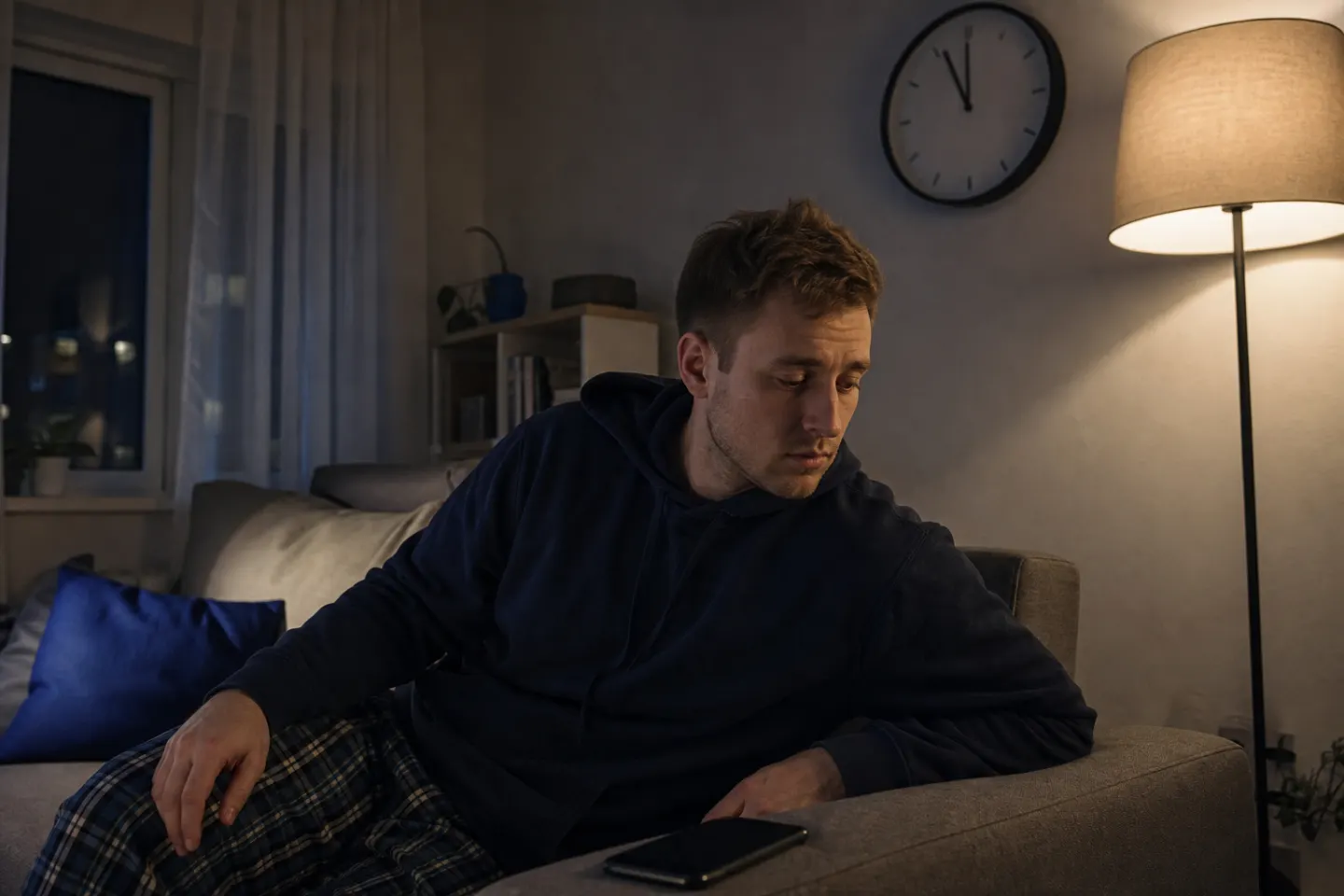
If prolonged sessions repeatedly displace sleep, plans, or relationships, include those costs in your assessment of the pattern. The article on lost evenings helps make them specific. If staying up late is the wider pattern, see revenge bedtime procrastination.
A session that is difficult to stop is worth addressing even if it does not happen every day. You do not need to match somebody else’s frequency before asking for qualified support.



No published comments yet.