
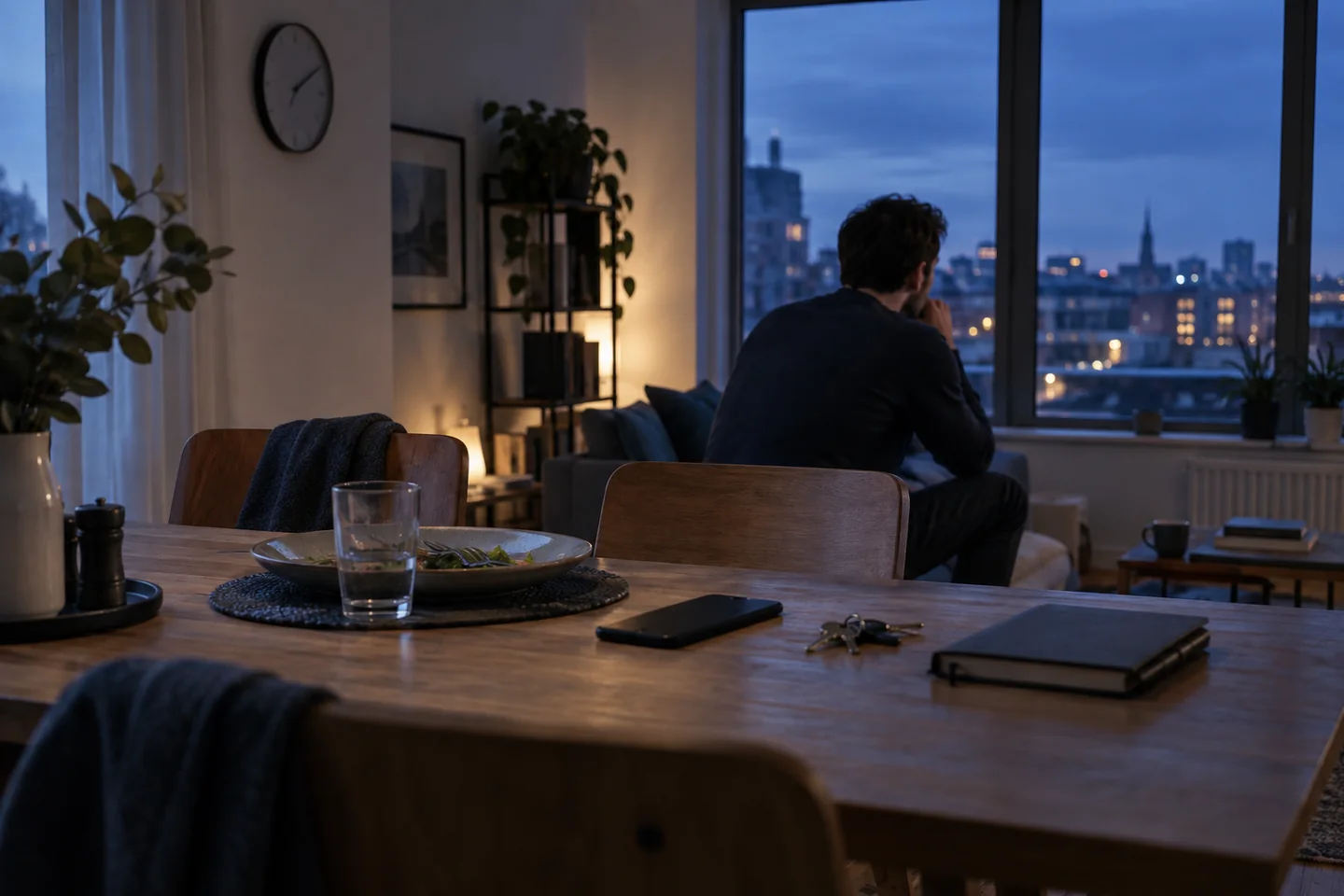
If you have no motivation to do anything, you are not unusual, and there is rarely a single reason. Sleep, stress, mood, health, alcohol and the way your evenings end can all drain the energy you need to start things. The useful question is not “what is wrong with me?” but “what is taking the energy, and when?”
A familiar version: you finish work, there is something you meant to do, and you pick up your phone for a few minutes. When you next notice the time, the evening has gone. Nothing dramatic happened, which is exactly what makes the pattern easy to dismiss.
Why do I have no motivation to do anything?
“I have no motivation” is a verdict. It is more useful to describe what actually happens: “I postponed the same task three times” gives you something to change; “I am wasting my life” leaves very little room to begin. If that verdict has become a sense that you have achieved nothing by 25 or 30, start with that page.
With that in mind, these are the common causes worth checking:
- Sleep debt. Short or broken sleep makes almost everything feel harder. The NHS lists not getting enough sleep as a common cause of tiredness and advises regular sleep times and no screens in the hour before bed. NHS: tiredness and fatigue.
- Burnout and overwork. If work takes everything, there may be nothing left for the rest of the day. That is a capacity problem, not a character flaw.
- Low mood or depression. The NHS lists “having no motivation or interest in things” and lack of energy among the symptoms of depression. NHS: symptoms of depression.
- Anxiety. Avoidance can look like laziness from the outside: the task feels threatening, so you put it off.
- Attention difficulties. Chronic trouble starting, organising and finishing tasks, going back to childhood, is worth discussing with a professional who can assess it properly, rather than self-diagnosing.
- Physical health. Anaemia, thyroid problems, diabetes and sleep apnoea are among the conditions the NHS links with persistent tiredness.
- Alcohol. The same NHS page advises not drinking too much for better sleep. A few drinks most evenings is worth counting honestly.
- Endless scrolling, gaming or streaming. Easy, always-available screen time can fill the evening without ever feeling like rest.
- Goals that are too big. “Get my life together” has no first step. A plan that fails every day slowly teaches you not to try.
No motivation but not depressed, or always tired?
If your mood is fine but you still cannot get going, look first at sleep, workload and how your evenings end. If you are also tired all the time, that points toward sleep and physical health rather than willpower.
When to see a doctor
Book a GP appointment if:
- low mood, loss of interest in things you used to enjoy, or hopelessness last most of the day, nearly every day, for more than 2 weeks (NHS);
- you have felt tired for a few weeks without knowing why, or it affects your daily life;
- tiredness comes with weight loss, mood changes, or someone has noticed you gasping or snoring loudly at night (NHS).
If you have thoughts of harming yourself or ending your life, get urgent help now. In the UK, call 999 or Samaritans on 116 123; in the US, call or text 988.
The cause people rarely check: how late-night sessions end
Some people never connect their lack of drive with what happens on their phone late at night, including porn. This is not the cause for everyone, and the evidence on porn and motivation is thin. But the time and the sleep are easy to measure.
Ince and colleagues’ qualitative study of 67 people with self-identified problematic use documented prolonged sessions and complaints after heavy use. These were participants’ accounts, not proof that porn caused every later symptom. Read the study.
In an interview study, Hanseder and Dantas spoke with 13 men who considered their use addictive. They described using it to escape difficult emotions or boredom, and difficulty stopping despite unwanted consequences. Read the interviews study. If that sounds familiar, see porn as a way to cope.
On motivation directly, one small experiment found that people asked to abstain from porn for three weeks later showed less preference for immediate over delayed rewards than people who gave up a favourite food. Negash et al. 2016. It is a single study using a lab task, not evidence that quitting restores drive.
How often you watch is a different question from whether it causes problems. Try this self-check:
- Do sessions regularly run past the time you planned to stop?
- Do you go to bed later than you wanted because of them?
- Did a task, a message or a plan move to tomorrow because of the evening?
- Do you reach for it mainly when you feel stressed, bored or low?
- Do you keep watching even when you are no longer enjoying it?
If several answers are yes, it is worth an experiment. If none fit, look elsewhere on the list above. For what keeps a session going, read “one more video”; for watching without enjoyment, see this guide.
What people describe
Lukas, 24, describes porn as his response to hard days and his reward for good ones, walking around “dazed”, feeling “terribly sleepy”, and regretting “the years I lost”. Going to the gym reduced the urge. Read his story (content warning: explicit descriptions of sexual material).
Ethan, 25, writes that he “could never finish at the time I had planned” and often shut himself in his room. A demanding job, long walks, friends and dancing slowly changed that. Read Ethan’s story.
Why can’t I stick to a routine or stay consistent at the gym?
Most routines fail at the start, not the middle. If the gym is at 7 a.m. and you fell asleep at 2 a.m., the plan was broken the night before. Before adding discipline, check what time you actually go to sleep.
Make the routine smaller than feels worthwhile: two sessions a week you keep beat five you skip. Attach it to something fixed, such as straight after work, before you sit down at home. When you miss a day, restart the next one instead of writing off the week.
A 30-day evening experiment
You choose the observation window. It is not a diagnostic test or a recovery deadline.
- Keep an evening review. Each night, note: What did I want from tonight? What did I actually do? Where did the plan change? What would have made a different choice easier?
- Set a screens-off time and write down when you actually fell asleep.
- Charge the phone outside the bedroom, keeping another way to receive essential calls.
- Add friction. Use your phone’s screen-time limits or a content blocker to make porn and endless feeds harder to reach late at night.
- Plan the difficult transition. If arriving home alone is where evenings slide, plan something realistic for that hour: a walk, a call, cooking.
- Protect one thing you want back: a chapter, dinner with someone, a small finished job.
After 30 days, compare your notes with your energy and mood. If you are still stuck, see a GP.


No published comments yet.