
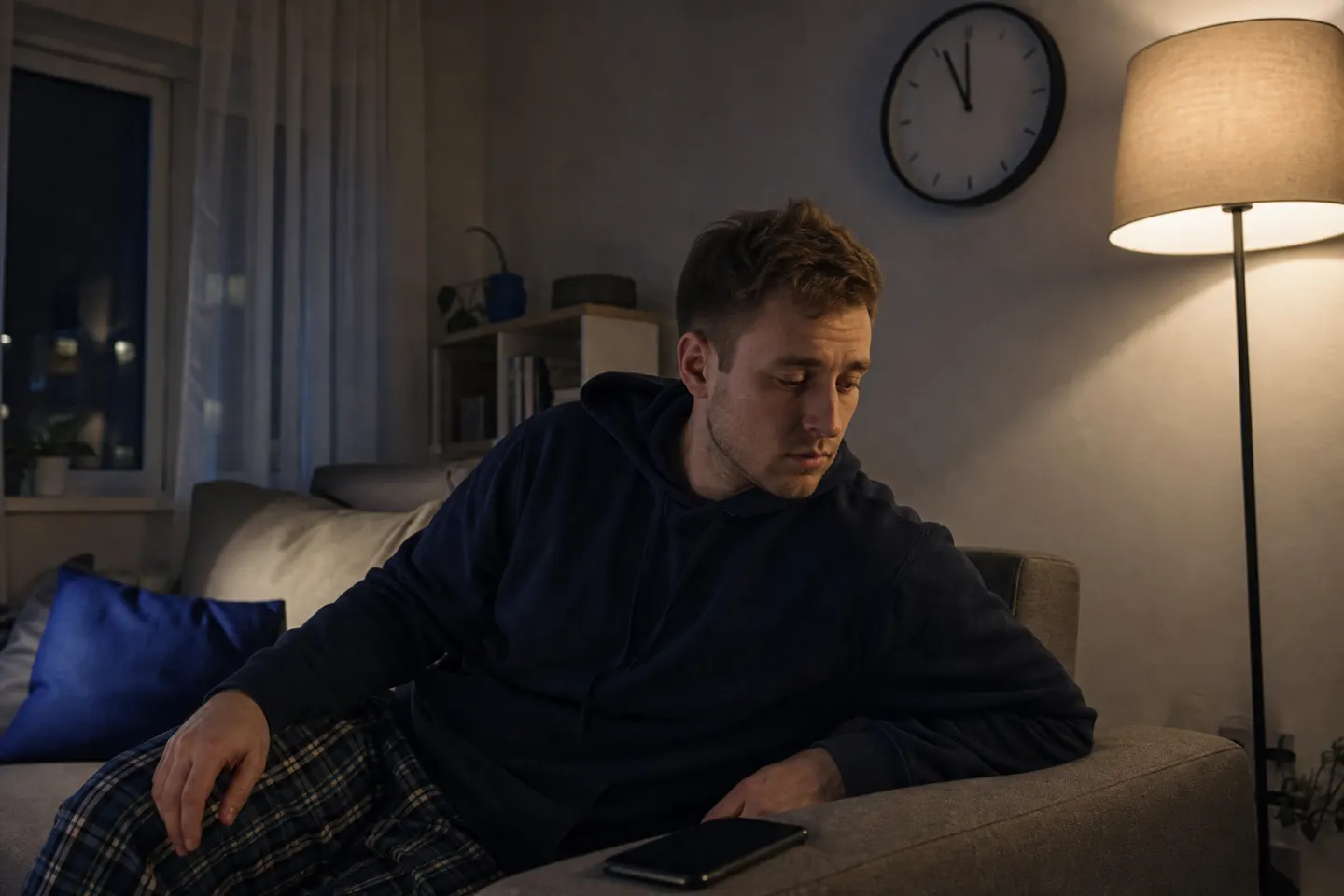
Revenge bedtime procrastination is staying up late on purpose, usually on your phone, even though you are tired and know tomorrow will be worse. It is common, and it is rarely about not knowing better. Most often it is an attempt to get back some time that feels like yours after a day that did not. The term took off on social media as a translation of a Chinese expression about long, stressful working hours. Sleep Foundation.
The useful question is not “why am I so undisciplined?” but “what is the last hour doing for me, and is there a cheaper way to get it?”
Why do I stay up late even when I’m tired?
Researchers call it bedtime procrastination: going to bed later than you intended, with no outside reason for the delay. In a representative sample of 2,431 Dutch adults, many regularly went to bed later than they wanted to, and this delay helped explain the link between weaker self-regulation and not getting enough sleep. Kroese and colleagues.
The reasons people give, and the research that fits them:
- A day with no control. If work, study or caring takes everything until late evening, the hours after it feel like the only free time. In a survey of 393 US servicemembers, those who reported more role overload also reported more bedtime procrastination. Barrow and colleagues.
- Tiredness itself. Self-control tends to be at its lowest at the end of the day, which is exactly when the decision to stop has to be made. Sleep Foundation. Across 43 studies, bedtime procrastination was moderately linked with lower self-control. Hill and colleagues.
- Being a night owl. The same review found a moderate link with an evening chronotype: some people are pushed by their body clock towards later nights and then have to get up for an early-bird schedule.
- Stress, anxiety and low mood. In 18 studies of university students, bedtime procrastination was linked with stress, anxiety and depressive symptoms, most strongly with stress. Azeem and colleagues. These are correlations; stress may drive late nights, and short nights certainly do not help stress.
- ADHD. Many people with ADHD describe this pattern. One review argues that a delayed body clock is very common in ADHD and may even explain some of its symptoms. Bijlenga and colleagues. If trouble starting and stopping things runs through your whole life, an assessment is worth considering rather than self-diagnosing. If porn is part of that pattern, see ADHD and porn.
- Feeds without an end. A film ends. A feed, a game queue or a video platform does not, so the moment to stop never arrives by itself. See why “one more video” turns into an hour.
The cost is real. The same 43-study review found moderate links between bedtime procrastination and shorter sleep, worse sleep quality and more daytime fatigue. Hill and colleagues. If you are always tired and foggy, late nights are one thread to pull, alongside medical causes.
Procrastination or insomnia?
They are different problems. If you stay up because you do not want the day to end, that is procrastination. If you go to bed and lie awake, wake several times, or wake early and cannot get back to sleep, that is closer to insomnia, which the NHS advises seeing a GP about if changing your habits has not helped or it has lasted months. NHS: insomnia.
See a GP too if you have felt low, hopeless or uninterested in almost everything for most of the day, nearly every day, for more than two weeks. NHS: symptoms of depression. If you are having thoughts of harming yourself, get help now: in the UK call 999 or Samaritans on 116 123; in the US call or text 988.
What often fills that last hour
Most articles on this topic stop at “scrolling”. For some people, whether they live alone or stay up after a partner has gone to sleep, the last hour is also when porn happens. It is rarely named, partly because it feels private and partly because it does not look like the problem. It looks like the reward.
That fits what research on late-night phone use suggests. In a study of 80 young adults with clinical insomnia, the most common reasons for delaying sleep were to regulate emotions, for reward and to help fall asleep. Lee and colleagues. Porn can do all three, which is why it can quietly take over the hour.
There is a link with sleep in the data too, though it cannot show which came first. In a survey of 1,008 young adults in Rhode Island, those who screened positive for insomnia had higher odds of screening positive for problematic porn use, and the link held only for heterosexual men. Noel and colleagues.
If you want to check whether this is part of your pattern:
- Is porn often the last thing you do before sleep?
- Do you stay up later than planned because of it, not just because of feeds or games?
- Does a late session start as “just a few minutes”?
- Do you use it to switch off when you feel wired, stressed or low?
- When you try to stop at a set time, is it harder than you expected?
If several are yes, the experiment below is worth trying with porn included. If none fit, leave that part out.
Can’t sleep without masturbating?
Many people masturbate to switch off at night, and many feel it works. In an online survey of 778 Australian adults, orgasm through masturbation was associated with the perception of better sleep and falling asleep faster. Lastella and colleagues. Measured night by night, the effect looks smaller: in a 14-day diary study of 159 mostly student participants in the Netherlands, only partnered sex with orgasm was linked with falling asleep faster and sleeping better; masturbation, with or without orgasm, was not linked with any change in sleep. Oesterling and colleagues.
So masturbating before bed is not a problem in itself, and doing it to relax is common (see is it normal to masturbate every day). It is worth a closer look when it feels like the only way you can fall asleep. A few questions help separate the habit from the hour:
- On nights you skip it, do you still fall asleep, even if it takes longer?
- Does it take a few minutes, or does finding the right video take most of an hour?
- Do you reach for it mainly when you feel anxious, wired or low?
If the problem is the hour of searching rather than the release, a first step is masturbating without porn, with the phone charging outside the bedroom. If you want to stop altogether, see how to stop masturbating. Either way, expect a few slower nights at first. The NHS advice for poor sleep applies here: go to bed only when you feel sleepy, wind down for an hour before bed, keep phones out of the last stretch before sleep, and get up at the same time every day. NHS: insomnia.
What people describe
Ethan, 25, writes that he “could never finish at the time I had planned”, with sessions that could stretch to four hours, and that he often shut himself in his room. A demanding job, long walks, friends and dancing slowly gave those hours another shape. Read Ethan’s story.
What is the 3-2-1 rule for sleep?
It is a countdown before bed, usually part of a longer “10-3-2-1-0” routine: no caffeine 10 hours before bed, no food or alcohol 3 hours before, no work 2 hours before, no screens 1 hour before, and zero presses of the snooze button. ColumbiaDoctors. Versions vary, and we did not find research testing the rule as a package. Its value is that it turns a vague intention into clear times, which is exactly what late nights lack.
How to stop revenge bedtime procrastination: a 30-day experiment
Choose a 30-day window to observe what changes. It is not a cure, and a late night is not a failure.
- Name what the hour is for. Rest, fun, being alone, not thinking about work? Write it down. The goal is to keep that, earlier.
- Move some “me time” into the evening. Even 30 minutes of something you chose, before 10 p.m., takes pressure off the midnight hour.
- Set a screens-off time and a fixed wake-up time, including weekends, and log when you actually fell asleep.
- Make porn and endless feeds harder to reach on your phone. Turn on a content blocker or your phone’s screen-time limits (step-by-step for iPhone and Android), and charge the phone outside the bedroom, with an ordinary alarm clock if you need one.
- End the day with something that ends: a chapter, a shower, a short podcast.
After 30 days, compare your sleep log with how your mornings felt. If late nights dropped, you have found the lever. If you still cannot sleep once in bed, take your log to a GP.
No published comments yet.