
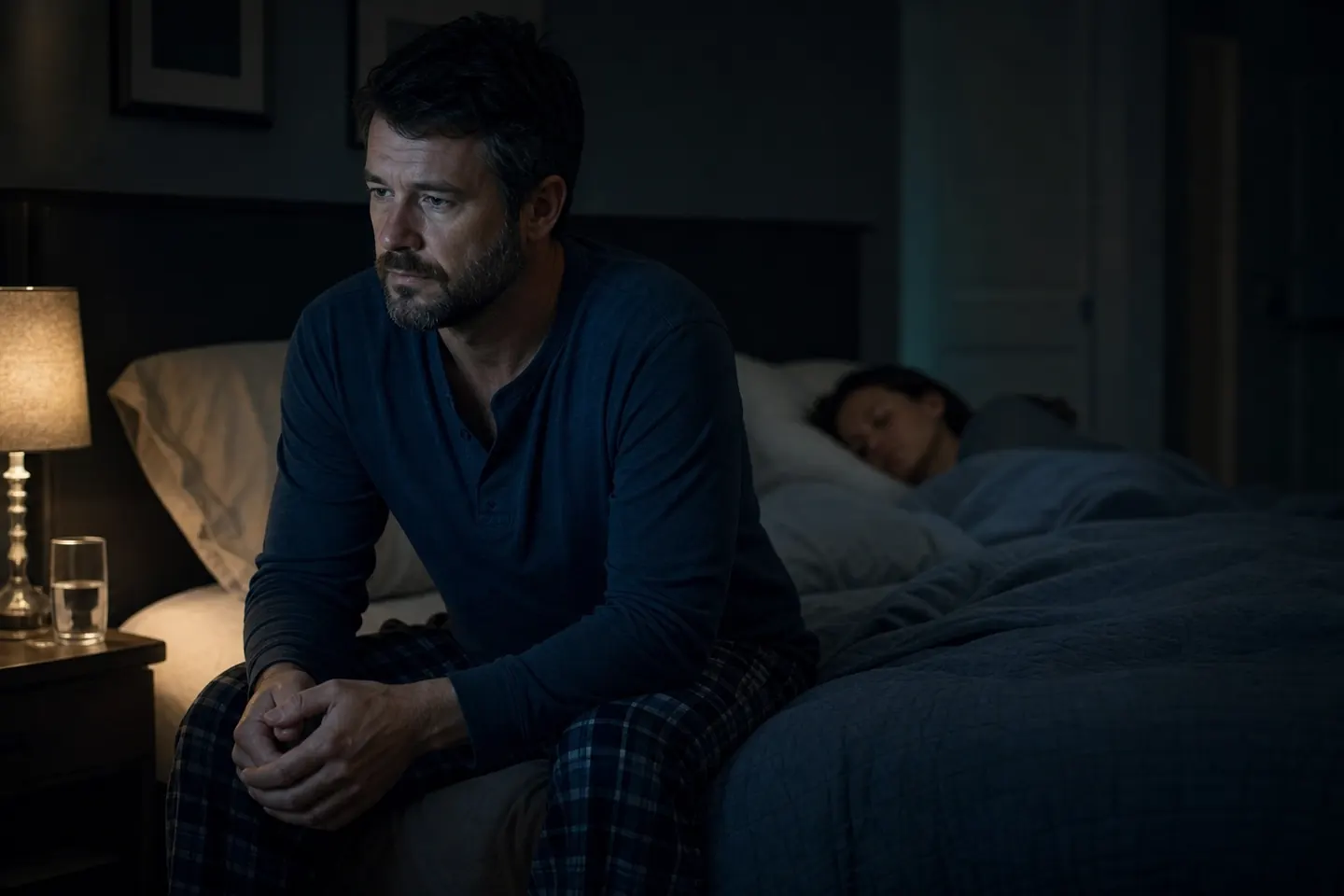
Low sex drive in men is common, and in your 30s and 40s it usually has ordinary causes rather than one hidden disease. Work stress, a new baby, poor sleep, drinking, a medicine, low mood, erection worries and a relationship that has gone quiet can all turn desire down. Hormones and health conditions matter too, which is why a check-up is worth it. And for some men, a porn habit has quietly absorbed the desire that used to go toward a partner.
This page is for men roughly 30 to 45. If you are in your 20s, see no libido as a young man. If you are the partner, when your husband doesn’t want sex is written for you.
Evidence strength: stronger for how common low desire is and its everyday causes; developing for how testosterone and age affect desire; early for how porn use relates to desire for a partner. The stories below are lived experience.
Does sex drive drop after 35?
Not as a cliff. In Britain’s national sex survey of more than 15,000 people, men who had been sexually active in the past year were asked whether they had lacked interest in sex for three months or more. The answer was yes for 14.5% of men aged 25 to 34, 17.2% aged 35 to 44 and 15.3% aged 45 to 54. Differences across age groups were small and not statistically significant. Low sexual function overall did become more common with age, and was also linked with depression and an unhappy relationship. Read the Natsal-3 study.
Cleveland Clinic says low libido affects up to 1 in 5 men at some point, and that many people notice changes more than once over the years. Cleveland Clinic on low libido. So “Is it normal at 37?” has two answers: it is common, and if it bothers you, it is still worth looking into.
Testosterone can drop with age, but in a European study of 3,369 men aged 40 to 79, low desire became more likely only as testosterone fell toward the low end of the range. Read the study. Turning 35 is rarely the explanation by itself.
What causes low sex drive in men?
The NHS lists relationship problems, stress, anxiety, depression, erection problems, some medicines and drinking too much alcohol among the main causes. NHS on low sex drive. In this decade of life, look at:
- Stress and overload. Cleveland Clinic includes stress from work, family and daily life, and anxiety, which raises stress hormones.
- A new baby. The NHS notes that looking after a baby can be stressful and tiring. Broken sleep and a changed routine affect fathers too.
- Tiredness and sleep. Exhaustion leaves little room for desire, and it can also be a symptom worth checking.
- Low mood. In the British survey, depression was strongly linked with low sexual function.
- Medicines. Antidepressants, blood pressure medicines and some others can lower desire. Talk to your prescriber rather than stopping anything.
- Alcohol, smoking and drugs. Cleveland Clinic notes that smoking can suppress testosterone.
- Health conditions. Diabetes, heart disease, high blood pressure, an underactive thyroid and high prolactin are on Cleveland Clinic’s list.
- Erection or ejaculation problems. When sex has become a test, avoiding it can look like low desire. See losing your erection during sex.
Usually it is two or three of these together.
Normal labs but no libido?
That result is common and useful. Endocrine Society guidance recommends diagnosing low testosterone only when symptoms come with consistently low results on fasting morning blood tests, repeated to confirm, and reserves testosterone therapy for men with confirmed deficiency. Read the guideline. If your levels are normal, extra testosterone is not a libido fix.
In the European study above, researchers defined age-related low testosterone by three sexual symptoms together, low desire, weak morning erections and erectile dysfunction, plus low levels. Low desire alone, with normal results, points elsewhere: stress, mood, sleep, medicines, the relationship, or habits.
Desire for your partner, or desire in general?
This is worth asking honestly. Some men feel no pull toward sex at all. Others still feel desire, but it no longer goes toward their partner.
In interviews with 30 men aged 30 to 65 in long-term relationships, the factors men described as boosting desire included feeling desired, exciting and unexpected encounters and intimate communication. Rejection, health problems and a lack of emotional connection pushed desire down. Read the study. Repeated rejection on either side can turn into a standoff where nobody initiates. In the British survey, about one in four men in a relationship reported an imbalance in interest in sex between the partners.
If desire is fine in general but has faded for your wife or partner, not attracted to my wife anymore goes deeper.
When should I see a doctor?
The NHS suggests seeing a GP if you are worried about your sex drive, or if you think a medicine may be affecting it. Go sooner if:
- low desire comes with erection problems or morning erections have mostly stopped;
- you feel constantly tired, low or flat, or have lost interest in things you used to enjoy;
- it began after a new medicine;
- you have diabetes, heart problems, high blood pressure or thyroid symptoms;
- it is putting real strain on your relationship. Cleveland Clinic suggests seeing a provider when low sex drive hurts your well-being or relationship.
Depression deserves care in its own right; porn and depression looks at how the two can feed each other. If you are thinking about harming yourself, get help now. In the UK, call 999 or Samaritans on 116 123; in the US, call or text 988.
Could porn be part of it?
This is the factor men rarely mention, and for many it is not the issue. In a European online study of 596 coupled men who reported decreased desire, with an average age of about 40, two-thirds masturbated at least weekly. Sexual boredom, frequent porn use and low intimacy in the relationship were linked with frequent masturbation, and the authors describe a pattern of porn-related masturbation that can be separate from desire for the partner. Read the study. The study is cross-sectional; it cannot show that porn lowered anyone’s desire.
A short self-check:
- Do you still feel desire with porn, but little for your partner?
- Is porn your usual response to stress, tiredness or a quiet evening alone?
- Do you turn down sex but masturbate on the same days?
- Has real sex started to feel like effort compared with a screen?
- Have you tried to cut back and found it harder than expected?
Several yes answers suggest your habits are worth looking at alongside the causes above, not instead of them. If none fit, this section is probably not about you.
What people describe
These are personal accounts, not evidence of how common each experience is.
Sam, 32, traces the change to becoming a father: “from the start of the pregnancy we stopped having sex, and then, you know, nappies, milk, feeding, nothing.” He describes escaping into porn and living “under constant stress.” Read his story. Content warning: sexual descriptions, past drug addiction and the death of a parent.
Rohan, 32, writes that “for a long time I hadn’t felt much pull towards porn, or towards real women either.” After quitting, his libido came and went for months. Read his story. Content warning: frank descriptions of sexual function and alcohol use.
Hannah writes from the partner’s side, about “constant excuses that my partner was tired, sleepy, stressed” before she found out about his porn use. Read her story.
A 30-day experiment
If the self-check sounded familiar, choose a 30-day window to observe what changes. It is not a cure or a recovery timeline.
- Record a starting point. Rate desire from 0 to 10 each day, and note sleep, alcohol, stress and mood.
- Leave porn out for the month. Decide separately whether to keep masturbating.
- Make porn harder to reach on your phone. Use a content blocker or your phone’s built-in screen-time limits, and charge it outside the bedroom.
- Protect sleep and drink less. These are the easiest causes to change.
- Reconnect without pressure. Talk outside the bedroom, for example: “I’ve noticed my drive has dropped, and I want to understand why. It isn’t about you.” Agree on affection with no goal of sex.
- Keep the check-up. The experiment runs alongside it.
If desire dips at first, note it without drawing conclusions. At the end, read your notes; several changes at once cannot show which one helped, and if nothing changed, your notes give a doctor or therapist a head start.


No published comments yet.