
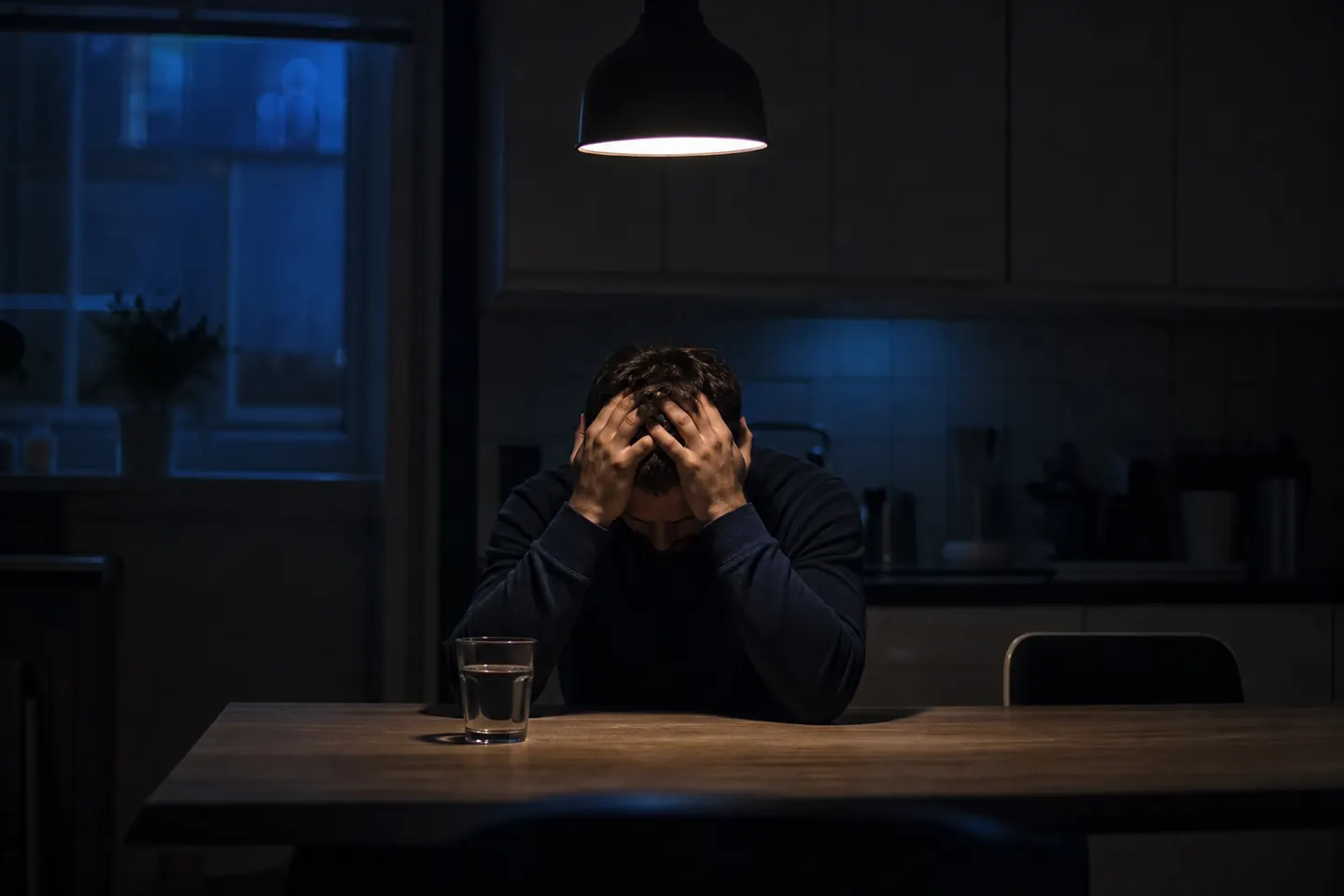
Guilt after watching porn usually comes from a gap: you did something that clashes with what you believe, promised, or want for yourself. That gap is real information, not proof that you are a bad person or that you are addicted. The useful question is what the guilt is pointing at. Sometimes it is a habit you want to change. Sometimes it is a belief you have never examined. Often it is both.
This page is about guilt and shame that last: the heaviness that follows you into the next day, the next week, or the next time you try to stop. If what you mean is the sudden drop right after you finish, start with post-nut clarity.
Evidence strength: stronger for the link between moral disapproval of porn and feeling addicted to it; developing for how shame and guilt keep a cycle of use going; early for hour-by-hour mood changes after use. The stories below are lived experience.
Why do I feel guilty after watching porn?
Researchers call the gap moral incongruence: acting in a way that does not match your own values. In a systematic review and meta-analysis, Grubbs and colleagues argued that for many people, feeling addicted to porn is better understood through this gap than through the amount they watch. Read the review.
The values can come from many places:
- Faith. Your tradition teaches that porn, lust or masturbation is wrong.
- A relationship. You agreed not to watch, or you know your partner would be hurt.
- Your own standards. You do not like who you are when you watch, or what you watch has drifted somewhere you never meant to go.
- Lost time. You planned an evening and lost it again.
None of these is irrational. Guilt is often your values doing their job.
Guilt, shame and accountability: what is the difference?
They feel similar, but they lead to different places. In a review of research on moral emotions, Tangney and colleagues described shame as a negative judgment of the whole self and guilt as a negative judgment of a specific behavior. Guilt tended to go with repair, such as apologizing or making amends. Shame tended to go with hiding, denial or escape, and proneness to shame was linked with a wide range of psychological symptoms. Read the review.
Put simply:
- Shame says: “I am disgusting. I will never change.”
- Guilt says: “I did something I don’t want to do. I want to do it differently.”
- Accountability says: “Here is what happened, here is what it cost, and here is my next step.”
You cannot switch shame off by deciding to. But you can notice which voice is talking and move, one sentence at a time, from the first toward the third.
Does feeling guilty mean I’m addicted?
Not necessarily. Guilt and loss of control are separate questions, and you can have one without the other.
In two US samples of adults who had used porn in the previous six months, Grubbs and colleagues found that feeling addicted was strongly linked with moral disapproval of porn, both at the time and a year later. The amount people actually watched was not clearly linked with feeling addicted over time. Read the study. In a much larger survey of 66,994 people in 42 countries, Bőthe and colleagues identified six profiles of porn use. Two showed raised risk of problematic use, one with some moral disapproval and one without, and religiosity was among the factors that set them apart. Read the study.
The World Health Organization’s diagnosis of compulsive sexual behavior disorder makes the same distinction. Kraus and colleagues, describing it for ICD-11, write that it should not be diagnosed based on distress that comes from moral judgments or disapproval. Read the paper. So the honest self-check is not “how guilty do I feel?” but “can I stop when I decide to, and what is it costing me?” Porn addiction, PPU and CSBD explains those terms.
If your faith says porn is wrong
Many readers ask some version of “Will God forgive me?”, sometimes adding “even though I keep doing it?” That is a question for your own tradition, and it is not ours to answer. What we can say is what the research does and does not show.
It does not show that your beliefs are the problem or that you should drop them. Moral incongruence describes a gap; it does not say which side of the gap should move. For some people, the right step is to change the behavior. For others, it is to look again at beliefs absorbed young and never questioned. Either can be a sincere choice.
Some practical points that hold across faiths:
- Talk to someone you trust within your tradition, if you have one, about forgiveness and starting again, not only about the rules.
- Look for a therapist who respects your faith. They do not need to share it. In a small trial of acceptance and commitment therapy for problematic porn use, 27 of the 28 men were members of one church, and viewing fell far more in the therapy group than on a waiting list. Read the trial. The sample was small and narrow, but it suggests secular therapy can work within a religious life. How to find a therapist covers what to ask.
- Watch for scrupulosity. If you feel driven to confess, pray or seek reassurance over and over just to feel clean, and it never lasts, that pattern may be closer to OCD than to ordinary guilt. The NHS lists asking for reassurance, repeating words in your head and “neutralising” thoughts among OCD compulsions. NHS on OCD symptoms.
When guilt keeps the cycle going
Guilt that leads to a plan is useful. Guilt that turns into shame can become part of the loop it is trying to end: tension, porn, shame, a promise of “never again,” more tension, and porn again as a way to escape the shame.
There is some evidence for this. In a narrative review, Coates and Meston found that sexual shame can play a key role in the cycle of hypersexuality, either keeping it going or pushing people to seek help. Read the review. In a small four-week study that tracked 22 people’s moods before and after porn use and masturbation, participants with high moral incongruence had temporary rises in shame, guilt and low mood afterwards, often lasting several hours, and stronger spikes in craving beforehand. Read the study. The sample was tiny, so treat this as an early signal, not a settled mechanism.
Signs that guilt has stopped helping:
- The “never again” promise comes every time, and the pattern does not change.
- You punish yourself with lost sleep, skipped meals or harsh self-talk.
- You avoid people, a partner or sex because of how you feel about yourself.
- You hide it from everyone, so no one can help.
- The guilt itself has become a trigger to watch again.
What people describe
These are personal accounts, not evidence of how common each experience is.
Josh, 30, remembers guilt from the very start: “you feel a kind of guilt you don’t understand. Everyone around you says it’s nothing bad, but something deep inside says otherwise.” Read his story. Content warning: it discusses depression and suicidal thoughts and contains sexual descriptions.
Felix, 21, describes the loop: “I tell myself never again, that it won’t get to me,” and adds that he cannot talk about it with anyone he knows. Read his story. Content warning: frank descriptions of masturbation and porn use.
Ethan, 25, writes that he wanted to tell a friend but “shame is holding me back.” Later he describes learning to see his sex drive as something he no longer “must fear or feel ashamed of.” Read his story.
What to do with the guilt
- Name the value. Write one sentence: “This bothers me because…” Faith, a partner, time, the content itself.
- Decide which side to work on. Change the behavior, examine the belief, or both. You do not have to settle this today.
- Swap punishment for review. After a lapse, look at what happened before it rather than at what is wrong with you. What to do after watching porn again walks through it.
- Tell one person. A friend, a partner, a faith leader or a therapist. Secrecy feeds shame.
- Make one concrete change to the situation where it usually starts. How to change your porn use helps you plan it.
When to get help
Talk to a GP or a therapist if the guilt lasts most days, if you have lost interest in things you used to enjoy, or if shame is keeping you away from people. Porn and depression looks at how low mood and porn use can feed each other.
If you are thinking about harming yourself, get help now. In the UK, call 999 or Samaritans on 116 123; in the US, call or text 988.



No published comments yet.